
The Oceanic Triumvirate
In the realm of marine pearls, three maritime regions define the apex of luxury: Broome in Western Australia, the Tuamotu and Gambier Archipelagos of French Polynesia (Tahiti), and the volcanic island bays of Lombok, Indonesia.
While auction catalogues and trade reports often group these under the broad umbrella of "South Sea Pearls," each geography operates under vastly distinct ecological, geological, and biological systems. For the collector and jewelry historian, understanding these distinctions is key to recognizing why each origin occupies an irreplaceable niche in haute joaillerie.
1. Comparative Environmental Architecture
- THE PACIFIC & INDIAN OCEAN TRIANGLE
- LOMBOK, INDONESIA
- Volcanic basalt bays (Rinjani runoff)
- Wallace Line equatorial currents (27-29°C)
- Deep water, sheltered coastal trenches
- ╱ ╲
- ╱ ╲
- ╱ ╲
- BROOME, AUSTRALIA TAHITI, FRENCH POLYNESIA
- Continental limestone shelf • Coral atolls & volcanic seamounts
- Extreme 10-meter tidal flux • Closed lagoon ecosystems
- Subtropical waters (22-28°C) • Tropical oceanic water (26-28°C)
2. Deep Comparative Matrix
- Feature — Lombok, Indonesia (Nusalume) · Broome, Western Australia · Tahiti, French Polynesia
- Parent Mollusk — Pinctada maxima (Gold-lipped) · Pinctada maxima (Silver-lipped) · Pinctada margaritifera (Black-lipped)
- Geological Substrate — Mineral-dense volcanic basalt · Ancient iron-rich continental sand · Calcium carbonate coral atolls
- Primary Chromatic Range — Imperial 24k Gold, Honey, Warm White · Silvery-White, Pale Cream · Peacock, Aubergine, Charcoal, Pistachio
- Signature Overtones — Warm Rosé, Gilded Honey, Apricot · Silvery-Blue, Pale Rose · Metallic Green, Magenta, Bronze
- Average Nacre Thickness — 1.8 mm – 3.0 mm (Rapid, dense layering) · 2.0 mm – 4.0 mm (Long, thick cycles) · 1.0 mm – 2.0 mm (Compact, dark layering)
- Water Temperature — 27°C – 29°C (Stable equatorial) · 20°C – 28°C (Significant seasonal shift) · 25°C – 29°C (Lagoon warmth)
- Cultivation Duration — 20 – 26 months · 24 – 36 months · 18 – 24 months
- Luster Character — Volumetric inner glow; warm satiny orient · Mirror specular, cool, crisp reflections · High-contrast metallic surface shine
3. Sourcing Archetypes: How Haute Joaillerie Allocates Each Origin
A. Broome: The Architectural Aristocrat
Australian South Sea pearls are celebrated for their monumental sizes (frequently reaching 16mm to 20mm) and icy, regal white coloration. The massive tidal flux of the Kimberley region forces the silver-lipped oyster to build exceptionally thick, durable nacre over 2 to 3 years. They are the quintessential choice for formal white-tie necklaces and neoclassical diamond solitaires.
B. Tahiti: The Nocturnal Alchemist
Black-lipped Pinctada margaritifera pearls from French Polynesia introduce mystery and drama to jewelry design. Their dark bodycolors—spanning from slate gray to midnight black—act as a dark backdrop that magnifies shimmering overtones of green, peacock, and violet. They are favored by contemporary designers seeking avant-garde contrast against colored gemstones like emeralds and rubies.
C. Lombok: The Solar Sovereign
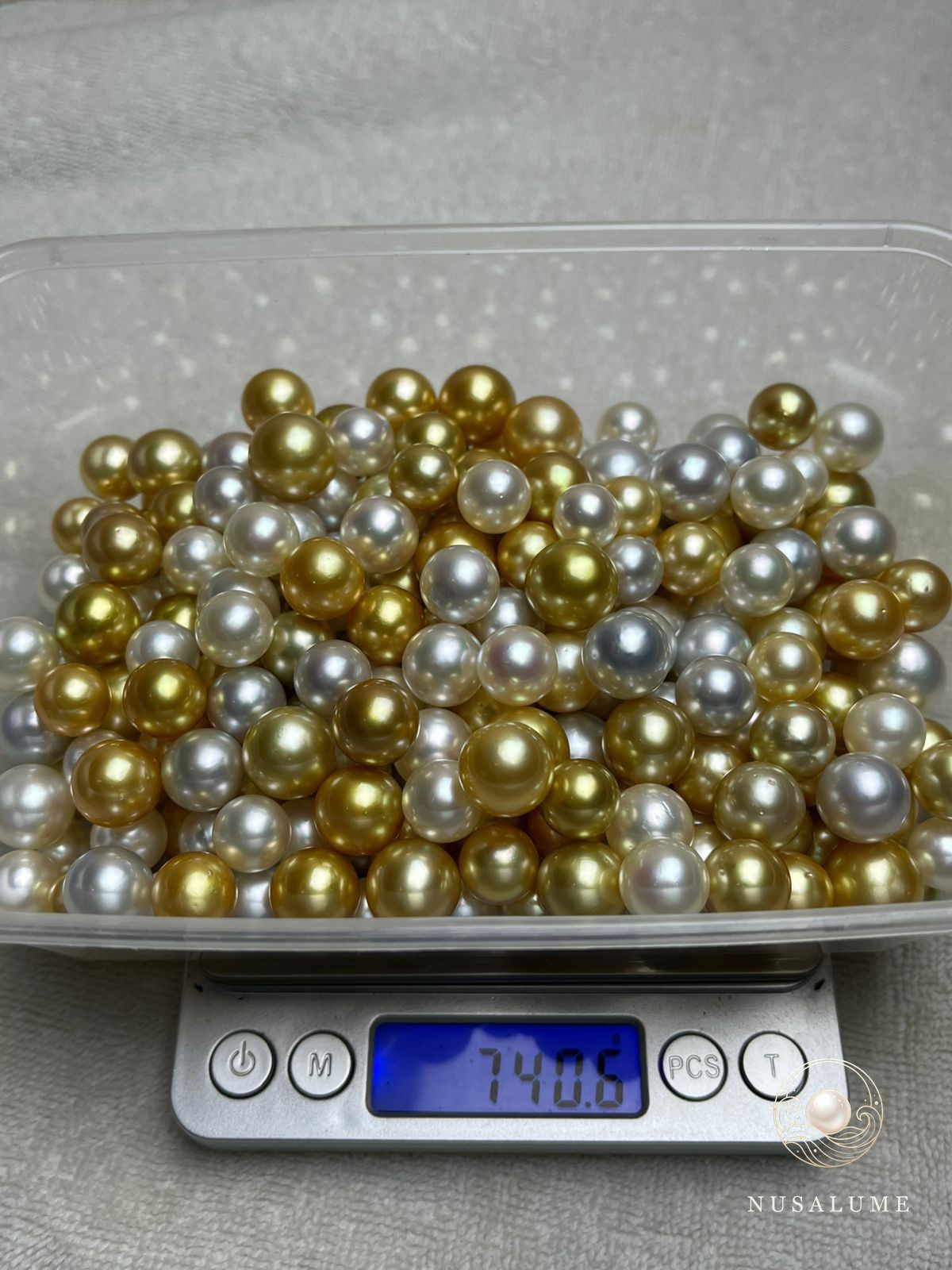
Lombok occupies a unique position in this triad as the world's premier sanctuary for natural Golden South Sea pearls. Because the gold-lipped oyster thrives in Lombok's volcanic, nutrient-dense bays, the pearls produced here possess an organic warmth and golden saturation that cannot be replicated in cooler Australian waters or Polynesian coral atolls.
For bespoke goldsmiths working in 18k yellow gold, unheated champagne diamonds, and natural colored sapphires, Lombok pearls provide a harmonious, sun-drenched palette that feels modern, approachable, and intimately connected to the warmth of the human body.
4. Market Trajectory & Investment Dynamics
Over the past decade, international auction houses in Hong Kong, London, and Geneva have observed a decisive shift in collector demand:
- The Ascent of Natural Gold: While supply of white pearls has stabilized through mature Australian operations, natural deep golden pearls of Indonesian origin have experienced rising demand, driven by discerning Asian and Middle Eastern collectors who revere gold as an emblem of longevity and sovereign grace.
- Traceability Premium: Collectors are increasingly willing to pay a premium for pearls backed by verifiable origin passports, avoiding blended lots that obscure provenance.
Summary
The connoisseur does not choose between Lombok, Broome, and Tahiti as superior or inferior; they collect them as three distinct geographical sonatas of the ocean. Yet for those who seek the warmth of the equatorial sun captured in living nacre, Lombok remains without peer.
Curatorial Advisory: Request our Comparative Harvest Dossier to view side-by-side gemological analyses of Lombok versus Australian harvest lots.