
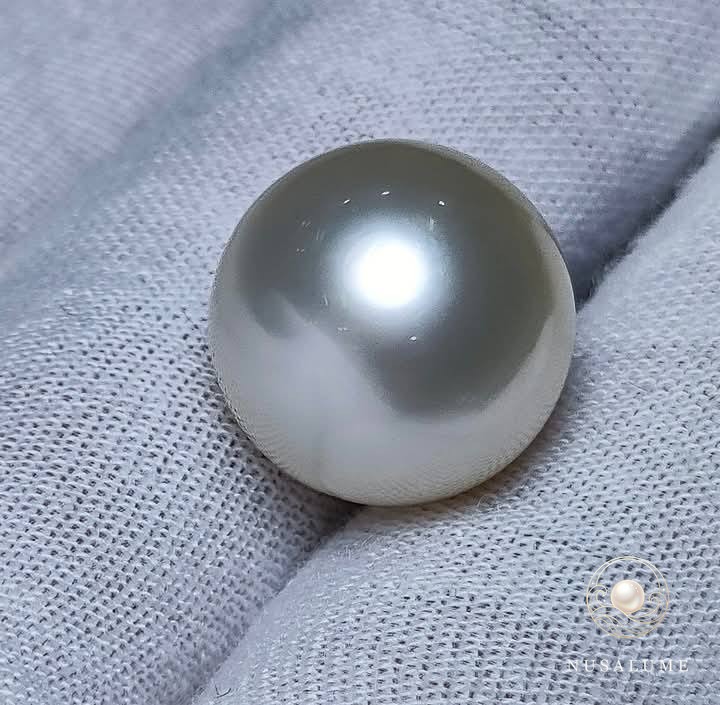
Abstract & Terroir Overview
In the vocabulary of viticulture, terroir denotes how soil, topography, rainfall, and microclimate imbue a harvest with an inimitable signature. In the realm of marine gemology, the concept of terroir is equally sovereign. The Indonesian island of Lombok—situated precisely along the biogeographical threshold of the Wallace Line—possesses an aquatic environment distinct from every other pearl-producing coastline on Earth. It is here, where deep equatorial trenches meet mineralized volcanic runoff, that the Pinctada maxima attains its warmest, most regal golden expression.
1. The Oceanographic Crucible: Lombok Strait and the Wallacean Currents
Lombok is framed by two contrasting oceanic forces: the calm Java Sea to the north and the deep, turbulent expanse of the Indian Ocean to the south. Between Bali and Lombok lies the Lombok Strait, one of the primary passages of the Indonesian Throughflow (Arlindo).
Through this narrow oceanic corridor surges an immense volume of equatorial water moving from the Pacific to the Indian Ocean. This continuous hydraulic engine provides three non-negotiable prerequisites for pristine pearl cultivation:
- Dynamic Thermal Equilibrium: Consistent, warm water temperatures (hovering between 27°C and 29°C year-round) keep the metabolism of the Pinctada maxima oyster active without subjecting it to thermal shock or dormancy.
- Super-Oxygenation: Powerful underwater currents continually circulate dissolved oxygen across the deep farming shelves, preventing bacterial stasis.
- Micro-Planktonic Bounty: The deep upwelling carries rich nutrients from the ocean floor, feeding the microscopic phytoplankton colonies upon which the giant oysters graze.
2. The Volcanic Touch: Mount Rinjani’s Mineral Imprint
While Australian pearl beds in Broome rest on ancient continental shelves of iron-red limestone and sand, Lombok’s coastal geography is forged by dynamic volcanic activity. Mount Rinjani, towering 3,726 meters over the island, serves as an endless reservoir of essential trace minerals.
Seasonal tropical rains filter through Rinjani’s rich volcanic rock formations, absorbing soluble basaltic minerals, silica, magnesium, and calcium carbonate before emerging into the coastal waters of bays such as Teluk Sire and Sekotong.
When the oyster incorporates these mineral-rich compounds into its biological mantle, the resulting aragonite crystals exhibit exceptional density and an uncommonly warm chromatic undertone. The light that reflects from a Lombok pearl does not produce the cold, silvery-blue cast typical of higher-latitude waters; it radiates with the honeyed warmth of the equatorial sun.
3. The Golden Spectrum: From Delicate Champagne to Sovereign 24-Karat
The gold-lipped Pinctada maxima is the only mollusk capable of secreting the lipochromic pigments responsible for natural golden pearls. Within the volcanic bays of Lombok, this natural pigmentation manifests across an extraordinary spectrum:
- Champagne Soft Glow Honey Dew & Warm Amber Imperial 24k Deep Gold
- (L-Champagne) (L-Aurum) (L-Sovereign)
- L-Champagne (3N Gold Equivalent): An ethereal, luminous cream tinted with soft yellow undertones. Prized by minimalist ateliers for pairing with brushed platinum and 18k white gold.
- L-Aurum (Warm Honey): A vibrant, saturated middle-gold displaying distinct rose and peach overtones. It reflects the brilliance of late-afternoon tropical sunlight.
- L-Sovereign (Deep 24k Gold): The apex of Pinctada maxima rarity. Characterized by dense, deep, uniform golden saturation that requires no artificial heat or radiation to achieve permanence. Occurring in fewer than 2% of annual harvests, these pearls are reserved for singular centerpieces in haute joaillerie.
4. Terroir Comparison: The World’s Great Pearl Seas
- Criterion — Lombok, Indonesia (Nusalume) · Broome, Western Australia · Tuamotu Archipelago, Tahiti
- Parent Mollusk — Pinctada maxima (Gold-lipped) · Pinctada maxima (Silver-lipped) · Pinctada margaritifera (Black-lipped)
- Geological Base — Volcanic basalt & mineral bays · Continental limestone & red sand · Coral atolls & basaltic sea mounts
- Signature Color — Deep Golden, Champagne, Warm Rose White · Cool Silvery-White, Pale Cream · Peacock, Charcoal, Pistachio, Aubergine
- Typical Overtone — Warm Rose, Honeyed Gold · Silvery-Blue, Green · Bronze, Violet, Metallic Green
- Water Temperature — 27°C – 29°C (Equatorial warm) · 22°C – 28°C (Subtropical variable) · 26°C – 28°C (Tropical oceanic)
- Growth Character — Rapid, dense aragonite layering · Slow, thick, structured layering · Dense, dark pigment accumulation
5. Maritime Custodianship: The Regenerative Reef Circle
A pearl oyster is an extraordinarily sensitive biosensor. It cannot thrive, secret nacre, or survive in polluted or degraded waters. Therefore, the cultivation of Nusalume pearls is inherently symbiotic with marine conservation.
In our designated pearl sanctuaries along Lombok's protected peninsulas:
- Natural Bio-Filtration: A mature Pinctada maxima oyster filters up to 150 liters of seawater each day, removing suspended organic debris and enhancing coastal clarity.
- Artisanal Diving & Community Partnerships: We reject mechanized industrial dredging. Local divers—inheritors of generations of maritime navigation—manually inspect, turn, and clean the oyster nets every two weeks, eliminating predatory biofouling organisms without toxic chemical washes.
- Habitat Protection: By establishing secure, non-trawling cultivation boundaries, pearl farms inadvertently create protected nursery sanctuaries where local reef fish, sea turtles, and corals flourish unthreatened by commercial overfishing.
Summary
Lombok pearls are not an accidental gift of the sea; they are the geological and biological confluence of volcanic soils, equatorial currents, and generational human patience. In every Nusalume pearl lies the unmistakable signature of its origin—a warmth that can never be synthesized.
Provenance Inquiry: Each Nusalume gem is cataloged with its specific bay of origin and harvest coordinates within the Lume Passport. Contact our concierge to review current origin lots.