
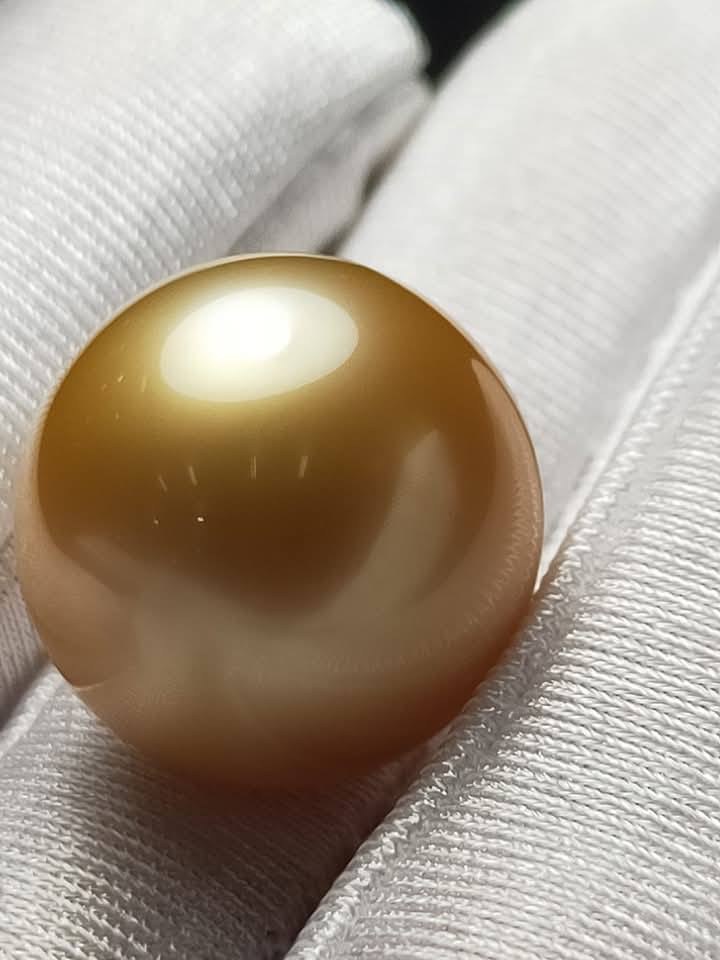
Abstract & Gemological Context
In the evaluation of fine gemstones, diamond value is anchored to the interaction of carbon lattice symmetry with external light. The pearl, however, operates upon an inverse optical phenomenon: light does not merely refract across faceted planes; it penetrates an organic architecture, ricochets across microscopic crystalline terraces, and emerges transformed from within. For the master goldsmith and discerning gemologist, understanding luster (orient) is the definitive distinction between a commercial gemstone and a museum-grade treasure.
1. The Architecture of Aragonite: Nature’s Microscopic Prism
At the microscopic threshold, the nacre (mother-of-pearl) secreted by the gold-lipped and silver-lipped oyster (Pinctada maxima) is not a uniform solid. It is a biological metamaterial—a structured composite consisting of roughly 95% calcium carbonate in the form of tabular aragonite crystals, bound by a 5% matrix of organic biopolymers (primarily conchiolin) and water.
Each aragonite platelet measures between 0.3 to 0.5 microns in thickness—a dimension that closely mirrors the wavelength of visible light. When oceanic conditions provide unbroken calm and pristine nutrition, the mantle epithelial cells of the Pinctada maxima deposit these platelets with mathematical cadence:
- Hexagonal and Polygonal Symmetry: The aragonite tiles arrange in alternating polygonal layers, resembling an ancient brick-and-mortar rampart.
- Constructive Wave Interference: As ambient photons strike the pearl, light penetrates multiple translucent layers rather than bouncing off the immediate exterior. Fractional light rays reflect off successive platelet boundaries, while others pass through to deeper strata.
- The Genesis of Orient: When these reflected waves exit the surface in phase, their amplitudes combine. This produces both sharp, specular surface reflections (luster) and the floating, rainbow-infused inner glow (orient or iridescence) unique to high-nacre specimens.
2. Depth Versus Polish: The Mirage of Chemical Enhancement
In commercial mass-market pearls, artificial chemical treatment (such as hydrogen peroxide bleaching, tumbling in maizema, or optical buffing compounds) is frequently employed to impart a temporary, high-contrast exterior sheen. To the untrained eye, this surface shine can momentarily masquerade as superior quality.
To the high jewelry atelier, however, the disparity is absolute:
- Gemological Metric — Untreated Organic Specimen (Nusalume Standard) · Chemically Polished / Treated Pearl
- Reflective Depth — Deep, volumetric luminescence originating from sub-surface strata · Flat, mirror-like exterior glaze with opaque chalkiness underneath
- Edge Sharpness — Reflections of light sources display crisp, distinguishable contours · Glare is diffused or blurred across micro-pitted surface enamel
- Chromatic Stability — Stable over generations; nacre retains organic moisture and resilience · Prone to desiccation, microscopic surface crazing, and dulling
- Touch Temperature — Noticeably cool to the skin, gradually acclimating to biological warmth · Heats rapidly; lacks dense thermal mass
True luster is an optical manifestation of patience. It cannot be expedited through laboratory intervention without deteriorating the delicate organic proteins that anchor the aragonite tiles.
3. Grading the Ineffable: Nusalume’s Five-Tier Luster Scale
While universal grading systems such as the A–AAA scale provide a commercial baseline, haute joaillerie demands a more rigorous framework. Within the Nusalume evaluation protocol, luster is graded across five disciplined parameters:
- Specular Mirror (Grade L-I / Sovereign): Reflections of the viewer’s eye, camera lens, or facial features are rendered with pinpoint clarity. Margins of light sources are razor-sharp. The phenomenon of overtone (rosé or golden orient) radiates unmistakably from within the core.
- Deep Metallic (Grade L-II / Atelier): High-intensity reflection with sharply delineated light source boundaries. The surface reveals an almost metallic density, characteristic of extended multi-year cultivation cycles.
- Silken Luminous (Grade L-III): Soft, dignified glow. Light source contours are perceptible but softened at the perimeter, resembling moonlight filtered through fine organza silk.
- Diffused (Grade L-IV): Light spreads broadly across the hemisphere without distinct reflection boundaries. Acceptable for accent pave, but unsuitable for singular bespoke centerpieces.
- Dull / Calcareous (Grade L-V): Lacking crystalline transparency; surface appears chalky. Rejected at initial harvest inspection.
4. Preservation of the Aragonite Lattice in the Atelier
For the bespoke goldsmith setting an untreated Pinctada maxima pearl, technical diligence during fabrication is paramount:
- Thermal Defense: Aragonite platelets decompose and lose crystalline moisture at temperatures exceeding 100°C (212°F). When soldering prongs or bezels, the pearl must be completely unmounted or protected with thermal insulating paste.
- Acid Avoidance: Ultrasonic cleaners and chemical dip solutions will irreversibly dissolve the surface aragonite and strip the nacre of its luminescence.
- Tension-Free Mounting: Because untampered nacre possesses a Mohs hardness of 2.5 to 4.5, mounting cups must be contour-matched to disperse lateral stress, preventing localized flaking around drill points.
Concluding Note for the Collector & Artisan
Luster is the soul of the organic gem—an indelible chronicle of every tide, moon cycle, and planktonic bloom sustained by the parent mollusk. When an atelier selects a Nusalume specimen, they do not acquire a static mineral; they encase years of quiet oceanic devotion, translated into living light.
Atelier Inquiry: To examine our current harvest of Grade L-I and L-II loose specimens, request the confidential Nusalume Grading Dossier and harvest provenance logs.